

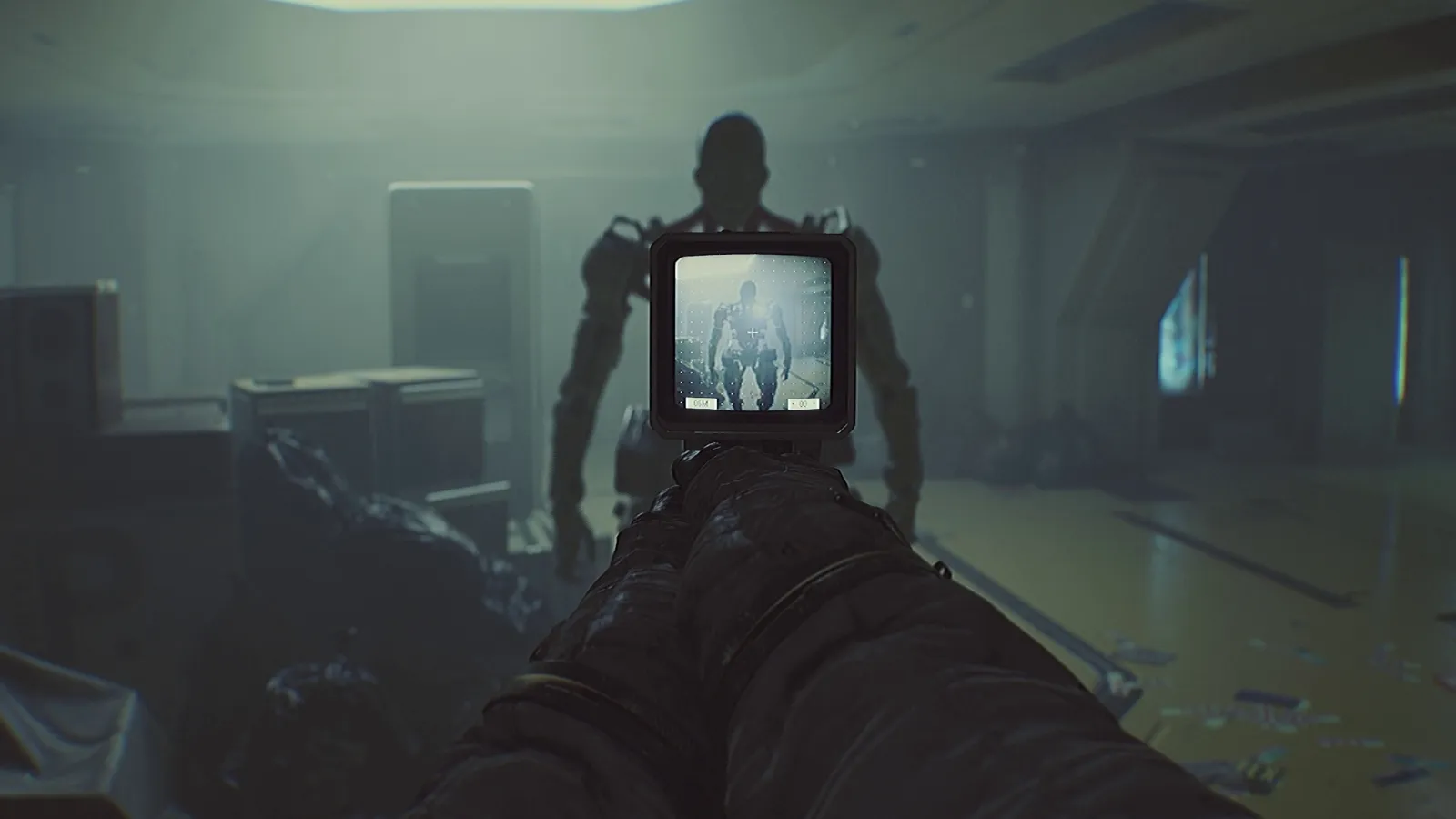
Intelligent, stylish, and unapologetically hands-off, Routine ranks among the most terrifying — and occasionally maddening — horror games I’ve encountered in a long time. Bold and merciless, it’s a masterclass in “show, don’t tell” horror that unsettled me far more than I expected… and that’s saying something coming from a seasoned horror fan.
Every sense is on constant high alert. My ears strain for the faintest footstep or the hum of electronics. My eyes scan the shadows for potential hiding spots. My hands — permanently cramped from gripping the controller so tightly — throb with tension. And yes, I can practically smell it too: dust, decay, and decades-old recycled air tinged with fried circuits. Normally, I’d retreat to the Pause menu to calm my nerves, but even that’s a risk here: the game doesn’t truly pause, leaving me vulnerable — and, as I’ve learned the hard way, able to die — while tinkering with settings. Thanks for that, Dead Space.
There are only two horror games I’ve never managed to finish: Alien: Isolation and the original Outlast. Both terrify me, mostly because jumpscares are completely unpredictable, and also because I hate being chased by enemies I can’t fight back. Routine delivers all that and more, cranking the tension even higher with smart, deliberate design choices — like manual save points (ugh!), randomized puzzles that prevent shortcuts or guides (ARGH!), and nightmare-inducing creature designs that feel ripped straight from my worst dreams (HELP!).
Originally announced in 2012 — two years before Alien: Isolation’s release, which it clearly shares some DNA with — Routine is one of the most atmospheric games I’ve experienced in years, and I mean across all genres, not just horror. You play as a software engineer sent to fix a malfunctioning security system at Union Plaza, a lunar tourist resort that’s eerily empty: no visitors, no staff, barely any functioning systems. Despite humanity’s obvious technological leaps that brought us to the Moon, Union Plaza feels delightfully retro. Think The Jetsons meets the original Alien: green-hued CRT monitors, minimal tech, and fabulously 70s-style patterned wallpaper that gives the place a nostalgic, almost naive vision of the future.
Enter your reliable CAT, the Cosmonaut Assistance Tool. It can overload electronics, track clues, see in the dark, and grant security access, but it’s also a bulky gadget reminiscent of an 1980s video camera, with painfully short battery life. Using it is hands-on — modules must be physically inserted, and connecting to the short-range Wi-Fi demands a manual button press. It’s charmingly fiddly… until you realize you might need to swap modules while a Type-05, a terrifying humanoid-like machine, is chasing you, or scramble to save at a wireless access point that could have a deadly robot lurking nearby.
Routine gives nothing away. No hints, no flashing objects, no “click here if stuck” prompts. It lets you fumble in the dark for hours, seemingly unconcerned by your frustration — until you finally notice a vent you somehow missed. The game’s clever design is both infuriating and brilliant, heightened by the careful use — or deliberate absence — of sound, with distant bangs and thuds keeping you constantly on edge.
Unsurprisingly, there’s no HUD. You can’t really tell your health status, so you never know how many times a creepy automaton can grab you before it’s game over. To check how many shots your CAT has left, you have to pick it up and inspect the battery physically. There’s no zoom when reading dimly backlit screens, making it a challenge to write memos and emails on flickering displays. Logging into systems takes precious time thanks to 1980s-style engineering and a groaning dial-up setup — and, yes, enemies can pull you out of hiding if they catch you in the act.
It’s those memos and emails that truly flesh out the story, which is impressive given how easy they are to miss (and how simple it is to get lost and think you’ve already explored an area). I can’t say the story fully made sense or ended satisfyingly or uniquely — too many loose ends left me wanting — but Routine’s mysterious narrative kept me engaged throughout.
Even for someone like me, terrified of being hunted in the dark by unkillable machines, Routine loses some of its edge partway through its roughly six-hour campaign. What initially terrified me eventually started to frustrate me instead. Manual saving is clever until your PC crashes, and the hands-off puzzling is impressive until you’re completely lost with no clue how to proceed. You can’t check your current objective unless you’re at a save station, decide when to use your flashlight, or carry a spare battery. There’s no map — which, for someone with the navigational skills of a turtle flipped on its back (again, me!), is merciless. And the inability to pause is interesting… until an important phone call or a dog standing in front of the TV reminds you just how inconvenient it can be.
By this point, even the Type-05s start to feel a bit mundane. Their stomping feet make it impossible for one to sneak up on you, and they’re often ridiculously dumb, sometimes failing to notice you even when you’re crouched just six inches behind a box in an open elevator. Half the time, they’re more of an annoyance than a threat, like a puppy with a new toy. That doesn’t mean I wouldn’t love to permanently disable them — temporarily knocking them offline rarely feels safe enough, which is obviously why permadeath isn’t an option — but with the abundance of “ammo” (read: batteries), you can usually neutralize them and slip away unscathed. They still manage to unsettle me, and the tension never fully fades, but their predictable stupidity makes them easier to evade. (I still can’t help wishing for a SOMA-style ‘Safe’ mode so I could explore without fear.)
As for the puzzles? Very few held me up for long — fear was the real obstacle, not the design — but some players might struggle, particularly because Lunar Software provides little guidance, making clues easy to miss. If you take anything from this, try to play as much of Routine as you can without leaning on a guide. Most puzzles are logical, occasionally maddening, and the thrill of discovering a solution by tinkering with your CAT is immense. That’s what I loved most: clever puzzles, intuitive tools, and a deeply unsettling atmosphere. It may not be for everyone, but for me, it left a strong impression.
Verdict
Routine managed to surprise me — a seasoned horror fan — in all the right ways. Its world feels tangible, the environments are detailed and engaging, and its mechanics and controls pull you fully into the experience. Combine that with frequent backtracking, relentless unkillable enemies, and minimal guidance, and it’s easy to see why Routine might divide horror fans in 2025. Even with its few frustrations, though, it remains one of the most genuinely terrifying games I’ve played in years.
