




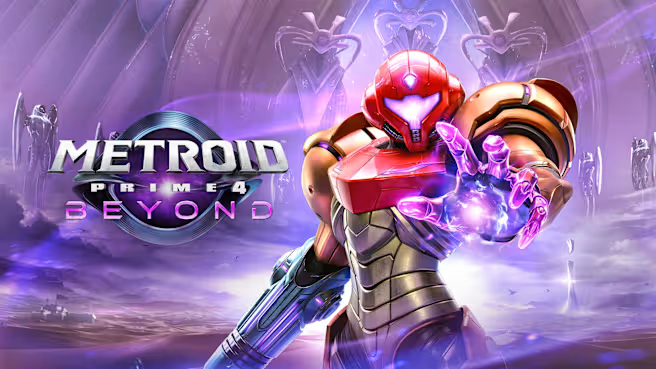
Metroid Prime 4: Beyond strives to be so many different things. It felt like the weakest Prime at times, while at other times I believed it might be the strongest since the first. An antiquated open-world hub connects stunning places that masterfully relive the original first-person exploration and lock-on shooting the series is known for. Even a crotchety Metroid fan like myself eventually warmed up to the talkative companions’ delightful personalities and memorable plot moments, even though they drop a few too many clues and one-liners.
And, happily, Retro Studios still mainly recognizes it’s necessary to give Samus her alone time, with a relaxing amount of exploration in utter isolation. While some of its attempts simply fail, far more of it succeeds, leading to an uneven but ultimately remarkable resurrection that, at its best, reaches astounding heights.
The story opens with Samus inexplicably teleporting to the planet Viewros, where she attempts to discover a route home while also uncovering the history of the ancient Lamorn race. This time, Samus’s newly acquired psychic powers from the Lamorn serve as the hook. In addition to giving you the ability to telekinetically alter specific objects, these purple-hued abilities provide Samus’s normal arsenal—which already includes bombs, morph balls, Charge Beams, and more—a fresh twist.
They result in a variety of problems, such as moving platforms around, aiming charged shots to strike several targets, cool momentum-based Morph Ball platforming, or finding enough psychic energy sources to power a nearby device.
The riddles and suit improvements are fantastic overall, if a touch familiar. Even though the psychic skills are primarily minor remixes of returning capabilities rather than something truly unique, I truly enjoyed using them to locate every single hidden item. I can only recall a handful of times where a solution felt exceptionally new – although it does include one fantastic cinematic moment that really stands out. It’s also not a huge complaint to remark that the eagerly anticipated continuation of one of the most well-known video game trilogies ever is staying quite close to the screenplay.
Combat also feels just what you’d expect from a modern return to Metroid Prime. You strafe around hostile creatures and machinery while locking onto adversaries and firing shots or missiles. But it’s more than just a simple rehash; Samus is incredibly easy to manage, with quick forward and backward dodges, better mobility when emerging from the Morph Ball, and quicker access to your visor, which is more helpful than ever because of its psychic qualities. You’ll also receive bright elemental beams that are handy in both combat and exploration (and also modify the look of Samus’ arm cannon when they’re equipped, which is a wonderful returning touch).
The riddles and suit improvements are fantastic overall, if a touch familiar.
Even though it’s rather simple, selecting your weapon and perfecting your aim is still enjoyable after all these years. Prime’s combat has always fared best when scarce encounters are ancillary to exploration, which is the model Prime 4 follows most of the time. It presents new enemies that need various weapons to defeat, such as a swarm of hovering robots guarding three weak points that must be destroyed with a slow-motion charged blast. The combat’s poor points are when it plays like a corridor shooter from the mid-2000s, sometimes concentrating a little too much on enemy waves that appear repeatedly.
At least those parts always conclude with something interesting, as the amazing selection of boss battles is a perfect mix of towering monsters and one-on-one shootouts. An early highlight is a gigantic plant protected by petals that thrashes its vines at you.
I played nearly entirely with dual-stick controls on the Switch 2 Pro Controller, which also features optional motion aiming for fine-tweaking when locked onto an enemy, like Splatoon.
This is my favorite setup, but I played with the Wii-inspired divided Joy-Con control method, which is also a fine choice. The Switch 2-exclusive mouse controls are practical, and it’s neat that you can swap to them on the fly just by placing your controller on a flat surface. However, I don’t see many people using them because the Joy-Con 2 is physically uncomfortable to use as a mouse for any length of time, especially considering how well the more conventional control schemes already function.
Samus’ new motorcycle also controls nicely, and the way it’s weaved into the plot seems surprisingly natural, but what you’ll really use it for is one of Prime 4’s biggest mistakes. You’ll mainly ride the bike in Sol Valley, a desert hub that serves as the middleground between each important place on its outskirts, sort of like what Hyrule Field was for Ocarina of Time. It’s mainly barren and lacking of many fascinating activities, as the same few enemy types crop up when you’re riding and all you do is shoot a basic projectile or charge into them to destroy them. The desert isn’t very huge, so it at least doesn’t take too long to get from point A to point B.
The problem is that it’s created as if that N64 Hyrule Field saw the Great Plateau from Breath of the Wild and said, “I can do that, too!”
Almost like it’s attempting to justify the motorbike’s existence, Prime 4 goes to considerable measures to guarantee you spend numerous hours riding throughout this dismal desert simply to reach the credits. It sprinkles an incredibly limited number of Breath of the Wild-like shrines on the map that house potential upgrades. The bite-sized puzzles inside those shrines are OK, but there’s absolutely no delight in discovering them when they’re just carelessly thrown around the visually unappealing sand, and it feels like a surface-level attempt to reproduce Zelda’s open-world enchantment that doesn’t really work.
A runtime-padding major purpose is connected to the repetitive desert.
This wouldn’t be a great concern, but Prime 4 ties a main purpose to its repetitive desert. Samus has to collect enough green energy to preserve the history of the Lamorn civilization before it’s lost to time, which is a very intriguing scenario. In reality, though, that simply means driving aimlessly through the desert and running into whatever green crystals you come across. Prime 4 would be much tighter without this mission, or perhaps without its half-baked desert at all. It’s the kind of runtime-padding filler that was already out of style the last time a Metroid Prime game was released.
The good news is that the locales you’re traveling toward are full of the strong Metroid Prime vibe and gameplay you came for. And Prime 4 is at its strongest when playing into the same characteristics that have defined this subseries since the GameCube: lonely, eerie exploration through magnificent, fully-realized landscapes that each have their own complex background to unravel. Structurally, the individual maps follow after Prime 2 and Prime 3’s more self-contained approach rather than Prime 1’s interwoven spiderweb that required returning locations numerous times over with multiple entrances and exits to each.
Because each location stands alone, Retro is able to give each one a distinct tone. For example, in some scenes, Samus is accompanied by Galactic Federation companions through more scripted scenes that reference the action elements of its sequel, Aliens, while in others, she is entirely alone and it leans heavily into the tense sci-fi horror isolation of Alien. For the majority of its around 15-hour length, this frequent genre switching between levels keeps things interesting—at least until it’s time to finish gathering all those green energy shards.
In these specialized regions, Prime 4 makes a case for itself as the best-looking game Nintendo has ever published. Its fanciful visual style is jaw-droppingly breathtaking at moments, with wonderful lighting, beautiful backgrounds, elegant architecture, and nicely detailed locations. It also sounds fantastic, with electronic noises blended with dramatic choral melodies that perfectly complement Prime’s mood. Samus’ famous visor effects return, like the way it fogs up in severe temperatures, or how rain droplets patter against it in a storm.
Its art direction goes hand-in-hand with its world design, since the way rooms are purposely framed upon blasting open their doors is often magnificent. To be sure, Prime 4 doesn’t approach the visual heights of the best-looking games on PC or other platforms, but a game this stunning running at a perfect 4K 60 fps on Switch 2 – with a smooth 120 fps option that decreases the resolution – is a major step forward for Nintendo.
Some locations rank among my favorites in the series, and when you carefully explore each one, Prime 4 lives up to the legacy of the trilogy. An early standout is Volt Forge, a gothic, futuristic factory set to a driving rock soundtrack. Its rich history is woven seamlessly into the level design: you can simply navigate each room and appreciate the intricate layouts, or scan every machine to learn its purpose and backstory, adding fascinating context that comes together when everything is in motion. These areas feel expansive, significant, and meticulously crafted—a hallmark of Metroid Prime’s worldbuilding.
Each region is fairly linear, typically offering one correct path even when multiple options appear. For instance, in a room with three doors, one might lead to a save point, another may be blocked until an upgrade is obtained, and the third is the correct path forward. This design works well for the Prime series, emphasizing mood, handcrafted tension, and unique sequences, though it contrasts with the nonlinear exploration the Metroid series pioneered over 30 years ago. Even in its more open sections, I never felt truly lost.
Verdict
It’s easy to see the vision Metroid Prime 4: Beyond was aiming for: blending the classic Prime formula with a character-driven story and a sprawling hub world. While it doesn’t fully achieve that ambitious goal—featuring an outdated open desert that often feels like filler and a cast that delivers both memorable moments and occasional excessive chatter—these flaws never come close to undermining the experience. Prime 4 remains an excellent return to form, with standout moments that largely overshadow its missteps.
Much of the 15-hour adventure is spent in atmospheric solitude, with the game knowing exactly when to let Samus operate alone. It nails the core elements that make a Prime game timeless: tense exploration of haunting environments, rich worldbuilding, stunning art direction, inventive twists on classic abilities, and seamless technical performance. Though a few underdeveloped aspects prevent it from feeling as cohesive as its predecessors, Prime 4 still soars to heights befitting the Metroid name.


