

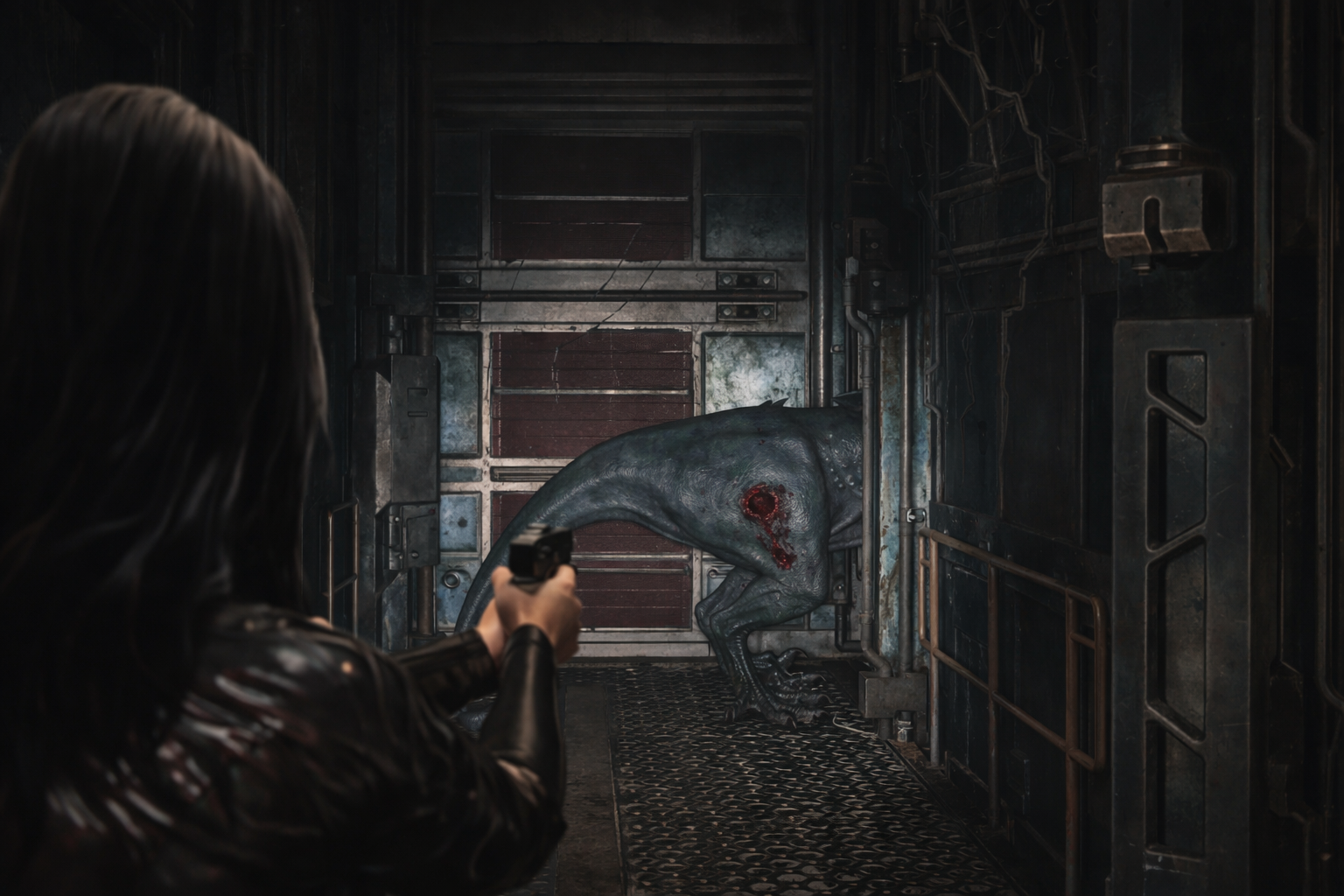
Let’s be upfront: Code Violet is a bad game. No shame if you were drawn in by its attractive protagonist and flashy trailers featuring dinosaur battles, but if you’re looking for a strong story, memorable characters, or tense action-horror gameplay, this space-station adventure falls flat. What you actually get is clunky third-person shooting, dull level design, and technical issues that make navigating the futuristic bloodbath feel frustratingly outdated.
The story leans heavily on science-fiction clichés, blending far-future space colonization, genetic modification, and a “final girl” survival premise. While some side stories and journal entries scattered across the wreckage are somewhat engaging, most cutscenes and narrative moments feel derivative, awkwardly animated, and forgettable. Even when the plot ramps up toward the end, with increasingly bizarre twists reminiscent of TeamKill Media’s Quantum Error (2023), the revelations feel rushed, underdeveloped, or overly convoluted. Supporting characters are shallow and serve mostly as exposition for Violet, leaving her struggles emotionally hollow and hard to connect with.
Violet herself comes across as a hollow character, lacking personal motivation beyond following orders, and she reacts with disbelief and tears when faced with strange or challenging situations. She seems intended to fit the archetype of a resourceful, tough heroine like Jill Valentine or Lara Croft—someone who can think their way out of trouble and shoot their way through the rest. However, unlike those iconic characters, whose agency is reinforced through heroic feats, witty dialogue, and introspective moments, Violet rarely expresses her own thoughts or feelings. She only feels competent when the player is controlling her, sneaking through corridors or taking down dinosaurs with a gun.
This is especially problematic because it turns what could have been a strong new character into a missed opportunity. It also makes the game’s suggestive camera angles and extensive outfit options feel less playful and more uncomfortable. While many games successfully use sexiness or flirtation as part of a character’s persona—characters who are confident and in control—Code Violet fails at this, creating an awkward and off-putting experience. In today’s gaming climate, where audiences are more accepting of provocative characters, this is a misstep that stands out.
At a distance, some portions appear good, but up close, textures can become muddled.
I played on a standard PlayStation 5 rather than a Pro, and at mid-to-far distances, some areas of Code Violet do look impressive—particularly the more imaginative spots, like when floating islands drift against a purplish sky. Up close, however, textures often appear muddied, and metallic surfaces reflect light in garish ways that clash with the intended grungy aesthetic. Much of the heavy metal corridors you navigate feel like uninspired sci-fi clichés, indistinguishable from any other game set in a locked-down space facility. Even Doom 3 executed this aesthetic more effectively over 20 years ago.
There are occasional touches of visual flair, like statues that seem more suited to a medieval castle than a space base. While you can infer some connection to late-game events, they mostly feel like they’re “just there.” Other odd details, like soda machines and oil paintings scattered throughout, stand out because they feel so out of place. I found myself pausing to wonder if some of these elements were AI-generated—they gave off that impression, though I couldn’t say for certain—but even so, they added a curious, if inconsistent, layer to the environment.
The striking outdoor skies feel almost ironic when stretched over the repetitive, bland grasslands you must cross to move between buildings. These areas are brief and feel more like extended hallways, with tall grass only serving as cover for patrolling enemies. There’s no map, though you don’t need one—the path forward is obvious, and there’s little room for exploration. While these zones might be intended as a break from the dark, claustrophobic corridors of the facilities, aside from a slightly brighter color palette, they feel just as monotonous to traverse.
Indoors, rooms that might offer something to investigate or shoot are connected by long, empty hallways, making the transitions between action zones feel dull and repetitive. This pattern persists across the few maps you explore, creating a slow, predictable pace. Games like Dead Space build tension by making every room feel dangerous, but in Code Violet, most spaces exist solely for walking through. The only incentives to deviate from the path are hunting for extra upgrade materials or searching for hidden keys and locker combinations—but even those rarely feel worthwhile, as collecting them often just prolongs the slog through the game’s weak combat system.
Until the camera is refocused, it can make some indoor encounters an entirely incomprehensible muddle.
Violet is agile and quick, fitting the standard for third-person action games of this type, and she even has a Resident Evil-style backstep dodge—something you’ll rely on heavily to create distance from approaching dinosaurs. A well-timed backdash can disrupt the raptors’ simple attack pattern of charging, swinging, and pausing. However, there’s limited room to maneuver before hitting walls or doors, and the camera often collides with these barriers faster than Violet does, turning any fight outside the center of a room into a confusing mess until you readjust the view. Indoors, this camera issue is a frequent frustration, adding tension but in an unintentional, aggravating way.
The enemy variety is also disappointing. Most non-boss foes are large or small velociraptors and poison-spitting dilophosauruses, each with predictable behaviors. Large raptors charge and swipe repeatedly, small raptors attack in packs in a simple hit-and-run pattern, and the spitters mostly remain stationary, only closing distance if you approach. Later in the six-hour campaign, gator-like creatures appear, but they’re trivial to deal with as long as you avoid their water zones. Overall, the encounters feel shallow and repetitive.
Any challenge from these dinosaurs mostly came from their erratic and sometimes downright stupid behavior, like getting stuck in the environment or disengaging if I simply moved the other way. Their high health and stun resistance mean they can often reach you and bite before dying, which isn’t truly dangerous but can be annoying—any hit has the potential to cause bleeding, which can kill if untreated. This applies even to the few boss fights, where the same basic strategy—backdash, dodge, and counter—remains effective, with almost no variation required.
At the same time, these enemies have an almost supernatural sense of where you are. Stealth rarely works because many encounters are scripted, with dinosaurs already aware of your presence when doors open, and so sneaking around is mostly pointless. Violet’s suit has a GlassVeil function that makes her temporarily invisible, which can amusingly trivialize encounters—even bosses will pause and wait for you to reappear before attempting any real attack.
The true obstacles, however, are the numerous bugs that plague the game. The sound mix occasionally malfunctions, critical skyboxes containing puzzle information sometimes fail to load, and weapons can display incorrect ammo counts or vanish entirely from your inventory. On the plus side, items drawn from storage never actually deplete in the review build, allowing unlimited healing at safe rooms. TeamKill Media has acknowledged some of these issues, such as the infinite storage exploit, and is reportedly working on fixes, though no timeline has been provided.
Verdict
ode Violet fails to live up to the Dino Crisis legacy you might have hoped for. It doesn’t even succeed as a clone of the other third-person shooters it borrows from. Its outdated level design and visual style make the game feel tired, while the convoluted story and flat, forgettable characters contribute little more than boredom. The enemy roster is weak and uninteresting, but the real threat comes from the numerous bugs in the review build, which, despite being a priority for developer TeamKill Media, severely disrupt the game’s pacing and balance.
