




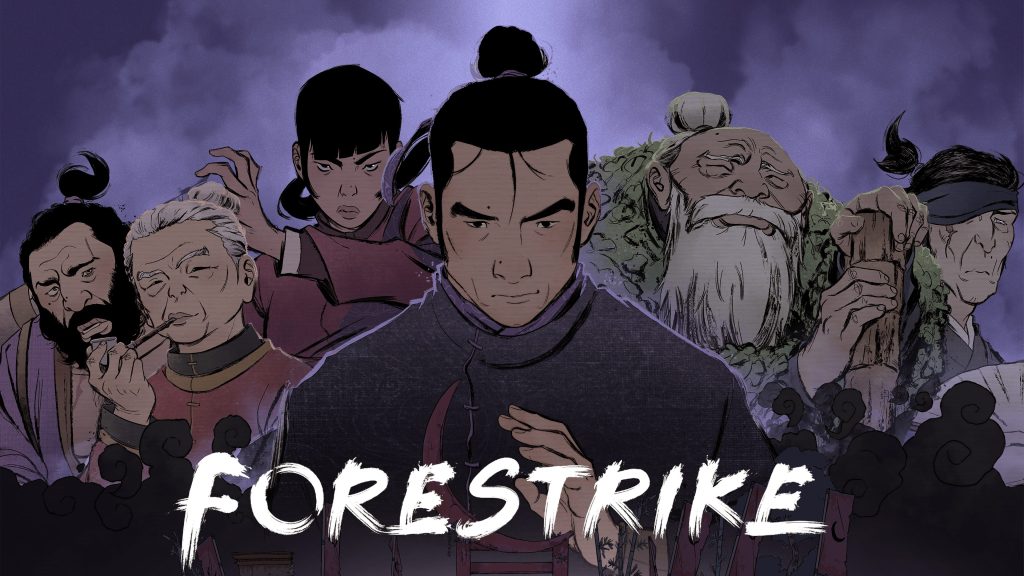
I’ve come to appreciate the process as a fan of fighting games. spending a lot of time in training mode studying the timing of button presses that are committed to memory in the hopes that the practice will pay off when it matters most. This may be the reason why I found Forestrike, a 2D martial arts-inspired roguelite that allows you to prepare your strategy before actually engaging in fight, to be so alluring. By combining straightforward hand-to-hand fighting with deft moments of leveraging your surroundings to your advantage, turning an enemy’s weapon against them, or creating friendly fire with a simple step to the side, it brilliantly conjures the sensation of classic kung fu battle choreography, all with simple spite art on a two-dimensional plane. This ingenious idea still manages to pack a huge punch, but the accuracy and memorization required to achieve these striking-looking feats may be punishing, especially given how easy it is for one error to cascade into many more, finally cratering a run.
In Forestrike, you take control of Yu, a teenage fighter who is a member of the Order of the Foresight, a group that is completely committed to serving their Emperor. Yu’s purpose is to rescue the Emperor from the manipulation of a creature known as The Admiral. Between each run in Forestrike, there is an unexpected amount of conversation as we discover more about The Order and the different masters who lead Yu on his adventure. In that sense, it’s similar to the pauses between Hades runs, but I usually found myself quick to move on so I could resume battling rather than constantly anticipating the new things folks had to say.
That lets you find the right combination of attacks, dodges, and techniques to defeat all of the enemies in the most efficient way possible. Defensive resources like blocks and dodges are extremely limited, and you’ll rarely go into an encounter with more than one of either. At first, it felt rather frustrating as I just continuously found myself being forced to burn my dodge or block against the first tough enemy, which meant I wouldn’t be able to avoid the attacks of the last one. Eventually, though, a visual language started to develop as I learned how enemies would react to my actions and how I could use those predictable tendencies to my advantage.
I could use my dodge resource to transfer the enemy on my left to the other side if he were charging me from the right, directly obstructing the attack. If I were up against an enemy with spikes on the front of their body, I could look for a form of puppet adversary that drops its head when killed, which could then be scooped up and tossed to kill the spiky foe from a distance. It was really enjoyable to figure out this visual language naturally, and I felt like I was improving during my runs—which is always a fantastic sensation in a roguelite—rather than because my character was growing stronger.
I was making progress because I was just improving, which is always a fantastic feeling for a roguelite.
The several martial instructors you take with you on each run, which determine the techniques you can employ, are what really make the gameplay sing. My favorite is Monkey, who uses a wild fighting style that relies on surprising opponents with dropkicks, bananas, and resting on the ground so that enemy attacks go right over and slam into the foe behind you. Talgun is the master of the Leaf style, which focuses primarily on redirecting enemy attacks so that your foes take each other out; Nodai of the Cold Eye style, which focuses primarily on blocking, restoring health, and brute force.
I like switching between them and observing the many strategies that become available the farther you go in a run. Each style calls for a whole different strategy to solve the battle puzzles. You acquire additional strategies that are added to the pool of randomly chosen rewards each time you defeat the boss in one of the four areas. This essentially serves as the ongoing advancement that gives you the extra advantage you’ll need to defeat each of the campaign’s four regions.
The main problem with this approach is that, given how rapidly things may go wrong with just one mistake, the level of precision needed in some of the later phases can get very out of control. I’ve had several combat encounters where all of my practice runs went perfectly, but on the real attempt, I was just a hair off on the timing of a single strike, which would basically cause my entire plan to fail and force me to improvise the remainder of the way, which usually results in either death or near-death.
Similar to Skeleton Crew Studio’s previous game, Olija, the sprite-based art design is purposefully simple and, for the most part, attractive. The actual combat animations are excellent, the 2D art is amazing, and the sprites themselves are surprisingly expressive despite their lack of detail. However, for some reason, the walk and run animations—some of the most clumsy I’ve seen in 2D pixel art—were not given the same attention. Yu only actually walks and sprints in between runs at the monastery, so it’s not a big concern, but it’s still an oddity in a game that otherwise looks fantastic.
Verdict
With a blatant respect for martial arts, Forestrike is an incredibly creative roguelite that blends battle and puzzle-solving. The different masters you can select from at the start of each run do a fantastic job of making each run feel new, and it perfectly captures that crucial sense of progression by gradually teaching you its visual language and boosting your power with better techniques as you go deeper. A weak plot slows down its progress, and the degree of accuracy needed in the later stages might result in some disappointing outcomes for otherwise promising runs. However, these setbacks typically make the final victory all the more delightful.


