

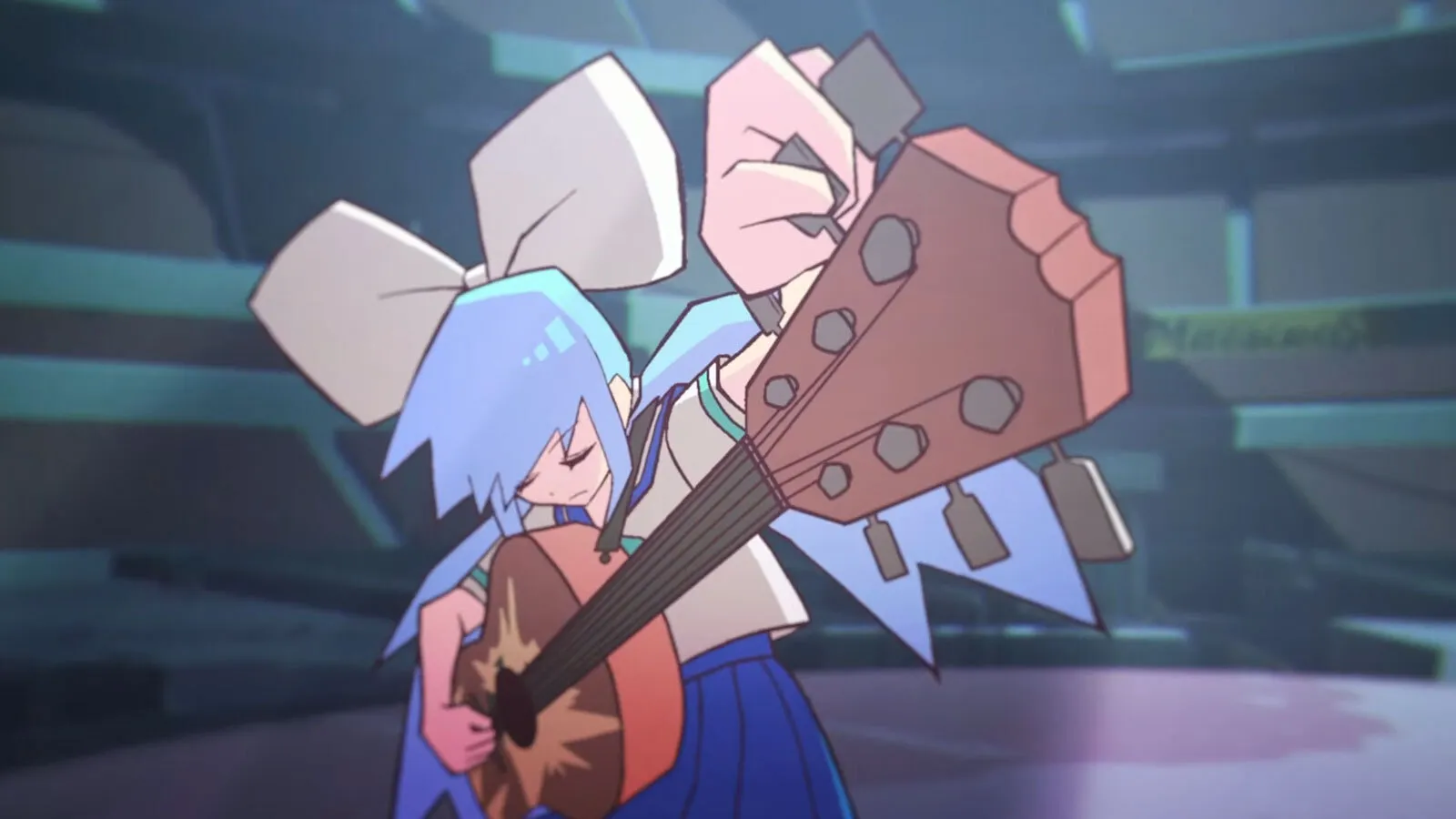
Unbeatable has an intriguing premise: a visually vibrant rhythm-adventure about a punk rock rebellion in a dystopian city where music is outlawed — think Jet Set Radio meets a story-driven Taiko no Tatsujin. In theory, it’s exciting, but the final product is a disjointed yet earnest experience. The game blends story-driven exploration with rhythm battles, but in practice, it feels like a conversation-heavy walking simulator punctuated by occasional musical segments and a few standout moments… plus an endless arcade mode that holds most of the rhythm-focused content. That mode is fairly enjoyable for a few hours, offering a solid track list and unlockable challenges, though some tracks are frustratingly locked behind day-one DLC.
In this world, music is forbidden, forgotten, and — conveniently — you’re the one who can revive it. Story mode follows vocalist Beat and her bandmates as they battle HARM, a police force enforcing the ban with deadly incompetence. The quirky characters and pun-filled names could be charming if the writing consistently delivered humor or emotional depth. Instead, the script only occasionally captures what it’s like to pursue music in a world that barely allows it. Most of the dialogue reads like an extended Discord chat between teens who equate randomness with comedy. It’s fun in short bursts but grows tiresome over the roughly eight-hour campaign.
It’s frustrating that so much of the game is filler, especially toward the end where the story could be most impactful. Even then, Unbeatable jumps between locations with almost no explanation. One moment you’re talking to a guard in prison, the next you’re in the cafeteria, then suddenly asleep, then doing work detail in the factory, and suddenly skateboarding through a platoon of guards on a pair of headphones. While there’s some internal logic, the game’s zones feel chaotic — like a cassette of disconnected vignettes that barely explain how you got from one scene to the next. It’s disorienting, not as a stylistic choice but as a failure of basic storytelling. Some dialogue sequences even repeat multiple times for no apparent reason, recycling cutscenes or conversations without purpose.
What’s even more surprising is how little rhythm gameplay exists in story mode before the final chapter. Most of your time is spent wandering empty spaces, talking to poorly written NPCs, or completing mandatory minigames that have little to do with the core rhythm experience found in arcade mode. Examples include a bartending minigame with loud jazz cues, a random batting cage, and a sewer puzzle where you keep running back and forth while your bandmates keep undoing your progress as a “joke.” Even when rhythm segments appear, they often feel disconnected from the story — mid-conversation, you could suddenly be in a yard battling an enemy with no context, and just thirty seconds later you’re back in your bunk discussing something else entirely.
The message it is attempting to convey takes itself too seriously to really embrace its ridiculousness
The story revolves around restoring music to the city as punk rock rebels, which is a solid premise. However, the execution is often shallow and heavy-handed, making it hard to feel any real stakes until the emotional payoff comes after the credits. The villains are written like annoying teens rather than credible threats. The game aims for an edgy, rebellious tone but never truly shows what you’re rebelling against or what rebellion costs in this world.
Consequently, the city feels less like a believable dystopia and more like a caricature designed for gameplay. Everything is exaggeratedly music-themed — you attach headphones to your feet to escape prison, Beat constantly argues about band life, and every NPC has a vaguely musical name. The aesthetic borders on parody, yet the game still takes itself seriously enough to fail at leaning fully into that absurdity.
The one bright spot is that music lovers will likely enjoy the references. Still, Unbeatable struggles with tone, juggling irreverent, internet-style humor with a heartfelt story about found family and artistic expression. While these elements could theoretically blend, the writing rarely succeeds, leaving the game to force its themes through breathless exposition, awkward drama, and cutesy characters who want desperately to seem clever.
When Unbeatable actually lets you play its rhythm game, it boils down to just two buttons: one for hitting ground enemies and one for jumping to hit aerial ones, all in time with the beat. It’s similar in style to Theatrhythm Final Bar Line. To its credit, the rhythm syncing works flawlessly — on PC at 1440p with a 180Hz G-Sync monitor, the beats lined up perfectly with the refresh rate.
The issue is that with only two inputs, the game’s difficulty scaling is limited to “more notes, faster.” On Normal, songs are almost comically easy. Switch to Hard or Expert, and the screen becomes a chaotic jumble of simultaneous inputs while the camera shakes, zooms, and bounces, which is more overwhelming than satisfying. You’re often just trying to parse the visual chaos. That said, there are some useful accessibility options: you can disable the default VHS filter, which unnecessarily glitches the visuals, and reduce camera motion, which helps counter the intense bouncing during rhythm sections.
The message it is attempting to convey takes itself too seriously to really embrace its ridiculousness
The music selection is solid overall. Story mode is more uneven — outside of the main themes and the band’s performances, much of the campaign’s filler tracks sound like a tongue-in-cheek take on Portland’s indie scene. The bright spot is that Beat’s band delivers a few genuinely catchy songs by the end. Arcade mode, meanwhile, offers consistently strong tracks, making it far more enjoyable than the story itself. Artists like Alex Moukala and Peak Divide provide some genuinely great music. While a few tracks are locked behind day-one DLC, there’s still plenty of high-quality content available for free.
Arcade mode functions like a fully realized rhythm game, with unlockable songs, a fun and extensive challenge board, leaderboards, and difficulty tiers from Beginner to Expert and beyond. It offers the polish and replayability the story mode lacks. Strip away the “adventure” elements, and that’s where the game’s true experience shines.
fusion art direction. The 2D character cutouts layered into cartoonish 3D environments look great, especially in locations like the town and beach, where the late afternoon light dances off the ocean. The pause menu also has this cool scratchy vinyl aesthetic that really sells the punk vibe. When you pause a session, there’s a neat record-scratch effect. These are the moments where you can see the vision underneath Unbeatable’s jank.
But strong art direction can’t save poor game design. For instance, the camera is frequently positioned in ways that make navigating each level confusing. You’ll often need to run toward areas of the screen that are partially obstructed by walls to trigger the camera to pan to the next room, leading to constant moments where you’re just wandering around trying to figure out where you’re supposed to go. And these environments feel empty and lifeless, more like stage sets than actual places.
Verdict
Due of its identity conflict, Unbeatable hides its useful but superficial rhythm gameplay behind jumbled dialogue and erratic pacing. The execution of this “punk rock dystopia” idea suffers from a lack of disciplined editing, and while the visual approach is very striking, it is sometimes undermined by confusing camera work. The poignant tale does ultimately come together into something truly moving, but it takes time to get there since clumsy transitions and monotonous language linger along the way. The arcade mode’s high score chase and rocking soundtrack may still appeal to rhythm enthusiasts looking for tight, concentrated action, but if that’s your goal, the story mode is definitely best avoided.
